

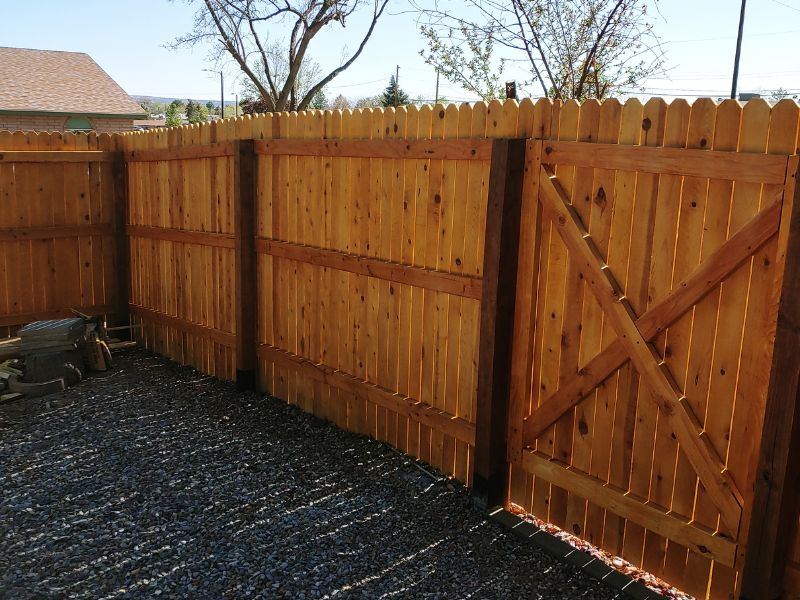
Upfront Installation: What You’ll Actually Pay
The initial investment for fencing materials varies significantly between vinyl and wood, with upfront costs often serving as the primary decision factor for property owners. In the Farmington, NM market, vinyl fence installation typically ranges from $25 to $40 per linear foot installed, while wood fence installation averages $15 to $30 per linear foot. For a standard 150-foot residential perimeter, vinyl costs approximately $3,750 to $6,000, compared to $2,250 to $4,500 for wood.
These price differences reflect material sourcing, manufacturing processes, and local labor rates. Wood materials benefit from regional availability and lower transportation costs, particularly for cedar and treated pine options popular in the Four Corners region. Vinyl requires specialized manufacturing and shipping, which increases base material costs by 30 to 50 percent. Labor costs for vinyl fence installation run slightly higher because the material demands precision cutting and specialized tools to handle high-desert temperature fluctuations that can make vinyl brittle during installation in cooler months.
Property size considerations matter significantly in this region. Many Farmington area properties span one to five acres, meaning perimeter fencing can easily exceed 500 linear feet. At this scale, the cost differential between materials becomes substantial, often reaching $5,000 to $10,000 for complete installations. Local fence contractors frequently encounter homeowners who initially lean toward wood purely on price, without considering the total ownership equation. The upfront savings of wood fence installation become less advantageous when maintenance, repair, and eventual replacement costs enter the calculation over a 20-year ownership period.
Durability in Desert Conditions: Real-World Lifespan
Lifespan projections reveal the starkest contrast between vinyl and wood fencing materials. Vinyl fencing systems routinely deliver 25 to 30 years of service life with minimal structural degradation, while wood fences average 10 to 15 years before requiring significant repairs or full replacement. These estimates assume routine maintenance, but the intensity and frequency of that maintenance differ dramatically between materials.
Farmington’s high-desert climate accelerates wood deterioration through intense UV exposure, low humidity, and temperature swings that can exceed 50 degrees Fahrenheit between day and night during spring and fall. Cedar and redwood naturally resist rot and insect damage better than treated pine, extending service life by three to five years in this environment. However, even premium wood species experience UV degradation that causes surface cracking, splintering, and color fading within 18 to 24 months without protective staining. Seasonal monsoon moisture in July and August creates wet-dry cycles that further stress wood grain, particularly in fence posts and horizontal rails where water can accumulate.
Vinyl withstands these environmental stressors with minimal impact. Modern vinyl formulations include UV inhibitors that prevent the chalking and brittleness common in older vinyl products. The material does not absorb moisture, eliminating the expansion-contraction cycles that weaken wood joints. Wind loading remains the primary structural concern for vinyl in this region, where spring gusts regularly exceed 40 miles per hour. Quality vinyl fence installation addresses this through proper post depth and reinforcement, ensuring the material’s inherent longevity translates to actual decades of service. Local fence contractors routinely encounter wood fences requiring complete replacement after 12 years, while vinyl installations from the same period still perform without structural issues.
Maintenance Reality: Time and Money Over 15 Years
Maintenance demands create the most significant operational cost difference between fencing materials over time. Vinyl requires only periodic cleaning with soap and water or a garden hose, typically two to three times annually to remove dust accumulation common in high-desert environments. Many property owners in the Farmington area utilize soft washing services to maintain vinyl fencing alongside home exteriors, combining both tasks into a single annual service call. This minimal maintenance translates to approximately $50 to $150 per year in actual costs.
Wood fence maintenance follows a far more intensive schedule. Protective staining or sealing must occur every two to three years to prevent moisture intrusion and UV damage. For a typical 150-foot residential fence, professional staining costs $600 to $1,200 per application in labor and materials. Between staining cycles, property owners should inspect for loose boards, rusted fasteners, and damaged sections, addressing issues promptly to prevent cascading failures. Wood fence repair becomes increasingly common after year five, with horizontal rails and fence posts most susceptible to rot where they contact soil or trap moisture.
The cumulative maintenance cost over 15 years typically exceeds $3,000 to $5,000 for wood, compared to under $1,000 for vinyl. This calculation assumes DIY staining and minor repairs for wood; professional maintenance services can double these figures. High-desert conditions make consistent maintenance non-negotiable for wood fences. A single missed staining cycle can reduce remaining service life by 30 to 40 percent as unprotected wood rapidly deteriorates under intense summer sun. Experienced fence contractors in the region emphasize this maintenance commitment during initial consultations, ensuring customers understand the true long-term investment rather than focusing solely on installation costs. Property owners who travel frequently or prefer low-maintenance landscaping solutions consistently find vinyl the more practical choice.
ROI Analysis: Which Fence Pays You Back?
Return on investment analysis requires examining total cost of ownership rather than isolated installation expenses. Over a 20-year period, a wood fence typically costs $2,250 to $4,500 for initial installation, $3,000 to $5,000 in maintenance and staining, and $2,000 to $4,000 for eventual replacement at year 12 to 15, totaling $7,250 to $13,500. Vinyl installation at $3,750 to $6,000 plus minimal maintenance of $1,000 over the same period totals $4,750 to $7,000. The cost advantage shifts decisively toward vinyl when examined across realistic ownership timelines.
Property value impact adds another dimension to ROI calculations. Curb appeal and functional fencing contribute to resale value, but buyer preferences increasingly favor low-maintenance materials. Real estate professionals in the Farmington market report that homes with newer vinyl fencing face fewer inspection objections and maintenance contingencies than those with aging wood fences requiring imminent replacement. The difference rarely affects final sale price directly but can accelerate time on market and reduce negotiation friction by $2,000 to $5,000 in typical transactions.
Specific use cases further refine ROI considerations. Properties requiring commercial fencing installations that must maintain consistent appearance, such as rental properties or business perimeters, benefit significantly from vinyl’s appearance retention and minimal upkeep. Conversely, customers prioritizing natural aesthetics for ranch style fence applications in rural settings may accept wood’s higher maintenance costs for the authentic appearance and easier field repairs. Local fence contractors help property owners model these scenarios with actual cost projections based on site conditions, property use, and long-term ownership plans. The most financially sound decision balances upfront budget constraints with realistic maintenance capacity and planned ownership duration, rather than defaulting to the lowest initial bid.
Making Your Decision: Framework for Smart Selection
Return on investment analysis requires examining total cost of ownership rather than isolated installation expenses. Over a 20-year period, a wood fence typically costs $2,250 to $4,500 for initial installation, $3,000 to $5,000 in maintenance materials and labor, and carries a replacement or major rebuild cost of $2,000 to $4,000 around the 12- to 15-year mark, bringing the total to $7,250 to $13,500. A comparable vinyl fence installation runs $4,200 to $7,500 upfront with maintenance costs under $300 for occasional cleaning supplies, yielding a total of approximately $4,500 to $7,800 over the same period.
Property value impact varies by market segment and buyer preferences in the Four Corners region. Vinyl fencing typically adds 1.5 to 2 percent to home resale value due to its association with low maintenance and modern aesthetics, particularly appealing to retirees and second-home buyers who represent a significant portion of the Farmington area market. Wood fencing appeals to buyers seeking traditional ranch aesthetics and natural materials, though the value addition diminishes rapidly if the fence shows weathering or deferred maintenance at the time of sale.
Energy efficiency considerations also factor into long-term value. Vinyl’s reflective properties reduce heat absorption compared to darker wood stains, creating measurable cooling benefits for properties with fencing along south- and west-facing exposures. In Farmington’s summer conditions, this can translate to 3 to 5 percent lower cooling costs for heavily fenced yards, adding $45 to $85 annually to the ROI calculation. Working with an experienced fence contractor ensures proper material selection, optimal installation techniques, and realistic cost projections that account for local climate factors, helping property owners make financially sound decisions rather than relying on national averages that may not reflect regional conditions.